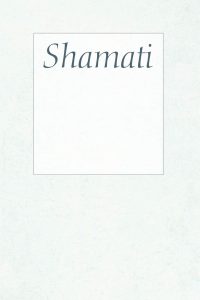





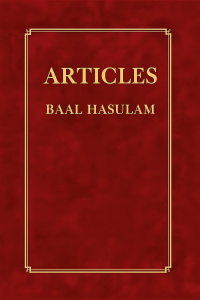
Among the books and manuscripts that my Rabbi would study from, there was one particular notebook titled Shamati (What I Heard). That notebook would go with him wherever he went and time after time he would delve into it. On his deathbed, in the wee hours of the night, he suddenly handed me that notebook and said: "Take this notebook and study it." Early next morning, with me by his side, his pure soul climbed into the heavens. The notebook holds a collection of essays written word for word from the mouth of Kabbalist Rabbi Yehuda Ashlag (Baal HaSulam), my Rabbi's father, immediately after they were spoken. Because of their uniqueness, we've kept them in their original style of language, which my Rabbi so eagerly absorbed and upon which he based his schoolings. For our English readers we've translated some of the essays and will continue to do so until the work is done. May these essays promote you on your spiritual path.
Rav Michael Laitman, PhD
It is written, “there is none else besides Him.” This means that there is no other force in the world that has the ability to do anything against Him. And what man sees, that there are things in the world that deny the Higher Household, the reason is that this is His will...
The Holy Zohar says: “He is Shochen (Dweller), and She is Shechina (Divinity).” We should interpret its words: It is known with regard to the Upper Light, that they say that there is no change, as it is written, “I the Lord change not.” All the names and appellations are only with respect to the Kelim (vessels), which is the will to receive included in Malchut—the root of creation. From there it hangs down to this world, to the creatures...
We discern many degrees and discernments in the worlds. We must know that everything that relates to discernments and degrees speaks of the attainment of the souls with regard to what they receive from the worlds...
We must know the reason for the heaviness felt when one wishes to work in annulling one’s “self” before the Creator and to not care for his own interest. One comes to a state as if the entire world stands still and he alone is now seemingly absent from this world; and leaves his family and friends for the sake of annulling before the Creator...
Lishma, it is not in one’s hands to understand, as it is not for the human mind to grasp how such a thing can be in the world. This is because one is only permitted to grasp, that if one engages in Torah and Mitzvot, he will attain something. There must be self-gratification there; otherwise, one is unable to do anything...
When one studies Torah and wants all his actions to be in order to bestow, one needs to try to always have support in the Torah. Support is considered nourishment, which is love, fear, elation, and freshness and so on. And one should extract all that from the Torah. In other words, the Torah should give one these results...
Through accustoming oneself to some thing, that thing becomes second nature for that person. Hence, there is nothing that one cannot feel its reality. This means that although one has no sensation of the thing, he still comes to feel it by accustoming to that thing...
It is written (Song of Songs, 2), “Until the day breathes, and the shadows flee away.” We must understand what are shadows in the work and what are two shadows. The thing is that when one does not feel His Providence, that He leads the world in a manner of “Good that doeth good,” it is regarded as a shadow that hides the sun...
The Holy Zohar interprets what our sages had written: “Three things broaden one’s mind. These are, a handsome woman, a handsome abode, and handsome Kelim (Vessels).” It says, “A handsome woman, this is the Holy Shechina (Divinity). A handsome abode, this is one’s heart; and handsome Kelim, these are one’s organs”...
Bear in mind, that when one begins to walk on a path of wanting to come to do everything for the Creator, one comes to states of ascents and descents...
Joy is considered love, which is existence. This is similar to one who builds a house for oneself without making any holes in the walls. You find that he cannot enter the house, as there is no hollow place in the walls of the house by which to enter the house. Therefore, a hollow space must be made through which one will enter the house....
The essence of one’s work should be how to come to feel taste in bestowing contentment to one’s Maker, since all that one does for oneself distances him from the Creator, due to the disparity of form. However, if one performs an act to benefit the Creator, even the smallest act, it is still considered a Mitzva (commandment/precept)....
A Pomegranate, he said, implies to what our sages said, “Even the vain ones amongst you are as filled with Mitzvot as a pomegranate” (Iruvin 19). He said, Rimon (Pomegranate) comes from the word Romemut (Loftiness), which is above reason. And the meaning will be that the “The vain amongst you are filled with Mitzvot.” The measure of the filling is as much as one can go above reason, and this is called Romemut...
The Romemut (greatness/sublimity) of the Creator means that one should ask of the Creator for the strength to go above reason. It means that there are two interpretations to the greatness of Creator:..
It is written, “Thou shalt have no other gods before Me.” The Holy Zohar interprets that there should be stones to weigh with. It asks about it, how is the work weighed in stones, by which one knows one’s state in the ways of God? It replies that it is known that when one begins to work more than one is used to, the body begins to kick and reject this work with all its might...
Our sages said this about the verse, “Woe unto you that desire the day of the Lord! Wherefore would ye have the day of the Lord? It is darkness, and not light” (Amos 5): “There is a parable about a rooster and a bat that were awaiting the light. The rooster said to the bat: ‘I await the light for the light is mine; but you, what need have you for light?’” (Sanhedrin 98,2). The interpretation is that since the bat has no eyes to see, what does it gain from the sunlight? On the contrary, for one who has no eyes, the sunlight only darkens more...
Crown means Keter, and Keter is the Emanator and the Root. Kedusha (Sanctity) is connected to the root, meaning Kedusha is considered being in equivalence of form with its root. It means that as our root, namely the Creator, wants only to bestow, as it is written, “His desire to do good to the creatures,” so Kedusha is only to bestow upon the Creator...
When concealment overpowers one and he comes to a state where the work becomes tasteless, and he cannot picture and feel any love and fear, and he cannot do anything in holiness, then his only counsel is to cry to the Creator to take pity on him and remove the screen from his eyes and heart...
The Holy Zohar says that the Creator hates the bodies. He said, that we should interpret it as referring to the will to receive, called Guf (lit. Body). The Creator created His world in His glory, as it is written, “Every one that is called by My name, and whom I have created for My glory, I have formed him, yea, I have made him”...
Concerning Lishma (for Her Name). In order for a person to obtain Lishma, one needs an awakening from Above, because it is an illumination from Above, and it is not for the human mind to understand. But he that tastes knows. It is said about that, “Taste and see that the Lord is good.”...
When one feels oneself in a state of ascent, that he is high-spirited, and that he has no desires but for spirituality, it is then good to delve in the secrets of the Torah in order to attain its internality. Even if one sees that although one exerts oneself to understand anything and still does not know anything, it is still worthwhile to delve in the secrets of the Torah, even a hundred times in one thing...
Torah is called Lishma primarily when one learns in order to know with utter certainty, within reason, without any doubts of discriminating the truth, that there is a judge, and there is a judgment. There is a judgment means that one sees reality as it appears to our eyes when we work in faith and bestowal. At that time we grow and rise from day to day because we always see a change for the better...
In the verse, “O ye that love the Lord, hate evil; He preserveth the souls of His saints; He delivered them out of the hand of the wicked,” he interprets that it is not enough to love the Creator, and to want to be awarded adhesion with the Creator. One should also hate the evil...
It is written, “O ye that love the LORD, hate evil; He preserveth the souls of His saints; He delivered them out of the hand of the wicked.” He asks, what is the connection between “hate evil” and “He delivered them out of the hand of the wicked?”...
Regarding things that come from the heart, enter the heart. Hence, why do we see that even if things have already entered the heart, one still falls from his degree?...
It is written, “The Lord is high and the low will see,” that only the low can see the greatness. The letters Yakar (lit. Precious) are the letters Yakir (lit. will know). It means that one knows the greatness of a thing to the extent that it is precious to one...
“The Lord is high and the low will see.” How can there be equivalence with the Creator when one is a receiver and the Creator is the giver? The verse says to that, “The Lord is high, and the low”...
In the verse, “I shall not die but live” etc. In order for one to reach the truth, there must be a sensation that if one does not obtain the truth, one feels oneself as dead, because he wants to live. This is the meaning of “I shall not die but live” etc. said about one who wants to obtain the truth...
“The Lord is thy shade.” If one thinks, the Creator too thinks of him; and when the Creator thinks, it is called “the mountain of the Lord”...
The most important is to not want anything but to bestow because of His greatness, because any reception is flawed. It is impossible to exit reception, but only to take the other end, meaning bestowal...
All that pleases the spirit of the creatures etc. He asked, “but we have found among the greatest and most renowned that they had disagreements. Thus, the spirit of the creatures is not pleased with it”...
A lot is an awakening from above, when the lower one does not assist in anything. This is the meaning of “cast Pur,” “the lot.” Haman was complaining and said, “neither keep they the king’s laws.”...
It is written (Leviticus 16:8), “And Aaron shall cast lots upon the two goats: one lot for the Lord, and the other lot for Azazel.” With Haman it is written (Esther 3:7), “they cast Pur, that is, the lot.”...
It is known that nothing appears in its true form, only through its opposite, “as far as light excelleth darkness.” This means that everything points to another, and by the opposite of some thing, the existence of its opposite can be perceived...
The verse says (Psalms 104): “Yonder sea, great and wide, therein are creeping things innumerable, living creatures, both small and great.” We should interpret the sea as the sea of the Sitra Achra...
Man is made of three bodies:
A. The inner body, which is a clothing for the soul of Kedusha (Sanctity).
B. The Klipa of Noga (Shell).
C. The serpent’s skin.
In order to save one from the two bodies, so that they do not interfere with the Kedusha, and in order for one to be able to use only the inner body, the counsel for that is that there is a remedy—to contemplate solely on things that concern the inner body...
We must understand several precisions in the Megilla...
A treasure is a vessel in which the possession is placed. Grain, for example, is placed in the barn, and precious things are placed in a more heavily guarded place. Thus, every received thing is called by its correlation to the Light, and the vessel must be able to receive the things. It is as we learn that there is no Light without a vessel, and this applies even in corporeality...
Kedusha (Sanctity), and the other comes due to a sin...
It is known that there is a right path and a left path. Right comes from the word the right, referring to the verse, “And he believed in the Lord.” The Targum says, right, when the Rav says to the disciple to take the right path...
It is written, “and they believed in the Lord, and in His servant Moses.” We must know that the Lights of Pesach (Passover) have the power to impart the Light of faith. Yet, do not think that the Light of faith is a small thing, because greatness and smallness depend only on the receivers...
In order to understand that, we must understand several other things...
Truth is what one feels and sees in one’s eyes. This discernment is called “reward and punishment,” meaning that nothing can be gained without labor. It is like a person who sits in his home and does not want to do anything to provide for his sustenance. He says that since the Creator is good that doeth good, and provides for all, hence He will certainly send him his needs, while he himself is required to no action...
One must examine if the faith is in order, meaning if one has fear and love, as it is written, “If I am a father, where is my honor, and if I am a master, where is my fear?” And this is called Mind...
There are two discernments in the Torah, and there are two discernments in the work. The first is the discernment of fear, and the second is the discernment of love. Torah is called a state of wholeness, meaning we do not speak of what situation one’s work is in, but we speak with respect to the Torah in and of itself...
The matter of the domination of Israel over the Klipot (lit. Shells), and vise-versa, the domination of the Klipot over Israel. First we must understand what is “Israel” and what is “The Nations of the World”...
“In the place where you find His greatness, there you find His humbleness.” It means that one who is always in true Dvekut (lit. Adhesion), sees that the Creator lowers Himself, meaning the Creator is found in the low places...
The primary basis is a path that is known to all. The care and the guard regarding the intellect is because it is built on the foundation of a question. If one encounters the known question, one must be armed and protected to stand guard and instantaneously reply with the known answer...
There should be a preparation on the discernment of “mind,” in that work which refers to the discernment of faith. This means that if one is neglectful in the work of faith, one falls into a state of wanting only knowledge, which is a Klipa (Shell), which is against the Holy Shechina (Divinity). Hence, one’s work is to strengthen the discernment of “mind” every time...
Shechina (Divinity).” It is so because before one is endowed with correcting one’s deeds to be in order to bestow, one feels the world only in the form of pains and torments...
“If you encounter this villain, draw him to the seminary, etc. and if not, remind him of the dying day”...
“A transgression does not put out a Mitzva (Commandment),” and a Mitzva does not put out a transgression. It is the conduct of the work that one must take the good path. But the bad in a person does not let him take the good path....
The matter of limitation is to limit the situation one is in and not want Gadlut (lit. Greatness). Instead, one wants to remain in one’s present state forever, and this is called eternal Dvekut (lit. Adhesion). Regardless of the measure of Gadlut that one has, even if one has the slightest Katnut (lit. Smallness), if it shines forever, it is considered having been imparted eternal Dvekut. However, one who wants greater Gadlut, it is called luxury...
It is known that the servitude is essentially to bestow contentment upon the Maker. Yet, one must know the meaning of bestowing, as this is commonly used, and it is known that habit wears off the taste. Therefore, we must thoroughly clarify the meaning of the word to bestow...
Torah is called “indication,” from the words “shot through.” It means that when one engages in the Torah, one feels one’s remoteness to the extent of one’s exertion. In other words, one is shown the truth, meaning he is shown his measure of faith, which is the whole basis of the truth...
About the verse, “will bring him as a burned offering to His will,” our sages said, “How so? He is he coerced until he says ‘I want.’” We must also understand what we pray, “Let there be a will,” since more than the calf wants to eat, the cow wants to feed, so why do we need to pray, “Let there be a will Above”?...
Kedusha (Sanctity), hence joy appears. However, we must know that there is also a discernment of a Klipa (Shell). In order to know if it is Kedusha, the scrutiny is in the reason. In Kedusha, there is reason, and in the Sitra Achra (other side) there is no reason, since another god is sterile and does not bear fruit...
“And Moses answered and said: ‘But, behold, they will not believe me,’” etc. “And the Lord said unto him: ‘What is that in thy hand?’ And he said: ‘A rod.’ And He said: ‘Cast it on the ground…’ and it became a serpent; and Moses fled from before it” (Exodus 4)...
A Mitzva that comes through transgression means that if one takes upon oneself the work in order to receive a reward...
Our sages say about the verse, “and round about Him it stormeth mightily,” that the Creator is particularly meticulous with the righteous. He asked: If they are generally righteous, why do they deserve a great punishment?...
Descends and incites, ascends and complains. One must always examine oneself, if one’s Torah and work do not descend to the abyss. This is because one’s greatness is measured by one’s measure of Dvekut (Adhesion) with the Creator, meaning on one’s measure of annulment before the Creator...
Understand what our sages said, “I was borrowed on, and I repay.” It means that the purpose of making the heaven and earth is the Light of the Shabbat. This Light should come to disclosure to the lower ones, and this purpose appears through Torah and Mitzvot and good deeds...
From Lo Lishma one comes to Lishma. If we pay close attention, we can say that the period of Lo Lishma is the more important time, since it is easier to unite the act with the Creator...
It is written, “The secret things belong unto the Lord our God; but the things that are revealed belong unto us and to our children forever, that we may do all the words of this law.” We should ask, “What does the text come to tell us, that the secret things belong unto the Lord?” We should not say that concealed means unattainable and that revealed means attainable. We can see that there are people with knowledge in the concealed part, as there are people who have no knowledge in the revealed part. And it cannot be said that this means that there are more people with knowledge in the revealed part than in the concealed part. (If so, you have given only a part of the whole picture)...
The issue of the giving of the Torah that occurred on Mount Sinai does not mean that the Torah was given once and then the giving was stopped. Rather, there is no absence in spirituality, since spirituality is an eternal matter, unending. But since, from the perspective of the giver, we are unfit to receive the Torah, we say that the cessation is by the Upper One...
We must take caution with “depart from evil,” to keep the four covenants.
The covenant of the eyes, which is to caution from looking at women. And the prohibition is not necessarily because it might lead to a thought. The evidence of that is that the prohibition applies also to an old man of one hundred years. Rather, the real reason is that it extends from a very high root: the caution is because if one is not cautious, one might come to look upon the Holy Shechina (Divinity).
The covenant of the tongue, to be watchful with truth and falsehood. The scrutinies that exist now, after the sin of Adam ha Rishon, are scrutinies of true and false. However, prior to the sin of the tree of knowledge the scrutinies concerned bitter and sweet...
Prior to the sin of Adam ha Rishon:
His Guf (body) was from Bina de Malchut de Malchut de Assiya;
And he had NRN from Beria and NRN from Atzilut...
He said that first will be the correction of the world, then will be the complete redemption, the coming of the Messiah. This is the meaning of “but thine eyes shall see thy Teacher,” etc., “and the whole earth shall be full of the knowledge.” This is the meaning of what he wrote, that first the interior of the worlds will be corrected, and subsequently the exterior of the worlds. But we must know that the externality of the worlds is a higher degree than the correction of the internality...
To understand what is written, “with a mighty hand, …and with fury poured out, will I be king over you,” we should understand that there is a rule that there is no coercion in spirituality, as it is written, “thou hast not called upon Me, O Jacob, neither hast thou wearied thyself about Me, O Israel...
“My soul shall weep in secret for your pride,” for the pride of Israel. He asks, “Is there crying before the Creator, because ‘strength and gladness are in His place’”? We must understand the matter of weeping Above. Weeping is in a place where one cannot help oneself. Then one weeps that the other will help him. The meaning of “in secret” is concealments and the contradictions that appear in the world...
Confidence is the clothing for the Light, called “life.” This is because there is a rule that there is no Light without a Kli (vessel). It follows that the Light, called “Light of life,” cannot clothe, but must dress in some Kli. The Kli where the Light of life is clothed is usually called “confidence.” It means that he sees that he can do every difficult thing...
After the Tzimtzum (restriction), the Upper Nine became the place of Kedusha, and Malchut, over which there was the Tzimtzum, became the place of the worlds. And there are two discernments to be made: 1) a vacant place, which is a place for the Klipot, whose essence is the desire to receive only for themselves; and 2) a free place, meaning a place that became free for inserting what one chooses—Kedusha or the opposite...
It is known that there is no reality without someone who senses the reality. Hence, when we say “Nefesh de Atzilut,” it means that we are sensing a certain measure of attainment in the Upper Abundance, a measure which we call Nefesh...
There is a discernment of “the next world,” and there is a discernment of “this world.” The next world is considered “faith,” and this world is considered “attainment”...
“With all thy offerings thou shalt offer salt,” meaning the covenant of the salt. The covenant corresponds to the mind. It is generally accepted that when two people do good to each other, when love acts between them, they certainly do not need to make a covenant. But at the same time, we can see that precisely when love acts, it is the usual time to make covenants. Then he said that the making of the covenant is for afterwards...
“One learns from one’s soul.”
It is known that the whole Torah is studied primarily for the needs of the soul, meaning for those who’ve already been awarded a discernment of a soul. However, they must still crave and search the words of Torah of others who attained, to learn new ways from them, which the previous ones have invented in their innovations in the Torah. Thus, it will be easy for them to advance in the High Degrees, meaning that through them they will advance from degree to degree...
“The Torah, the Creator, and Israel are one.”
Hence, when one is studying Torah, he should study Lishma. This means that he studies with the intention that the Torah will teach him, meaning as is the name of the Torah, which means “instruction.” And because “the Torah, Israel, and the Creator are one,” the Torah teaches one the ways of the Creator, how He is clothed in the Torah.
Atzilut is considered from the Chazeh up, which is only vessels of bestowal. BYA means reception in order to bestow, the ascent of the lower Hey to the place of Bina...
Panim and Achor (face and back).
Panim means reception of bounty or bestowal of bounty.
Negation is called Achoraim (posterior), meaning neither receiving nor giving...
It is known that because of the breaking, sparks of Kedusha fell into BYA. But there, in BYA, they cannot be corrected, and hence must be elevated to Atzilut. And by doing good deeds and Mitzvot with the aim to bring contentment to one’s Maker and not to oneself, these sparks rise to Atzilut...
Faith is discerned as Malchut interpreted in the mind and the heart, that is, bestowal and faith. And opposite faith there is the discernment of the “foreskin,” which is knowing, whose way is to appreciate the discernment of the foreskin...
There is the discernment of Ze (‘this’ in male form) and the discernment of Zot (‘this’ in female form). Moses is considered Ze, which is the King’s best-man. The rest of the prophets are considered Zot or Koh (the letters Chaf and Hey), which is the meaning of Yadecha (thy hand), a left Vav. There also is the discernment of the right Vav...
It is written, “and said unto him: ‘Where art thou?’ And he said: ‘I heard Thy voice,’” etc., “‘and I was afraid, because I was naked; and I hid myself.’…lest he put forth his hand, and take also of the tree of life,” etc.. “So He drove out the man”...
It is written, “And ye shall take you on the first day the fruit of goodly trees, branches of palm-trees, and boughs of thick trees, and willows of the brook” (Leviticus 23:40).
And we should interpret “fruit of goodly trees”: A tree is considered righteous, called “tree of the field.” “Fruit” is the progeny of the tree, meaning the progeny of the righteous, which are the good deeds, which should be in the form of adornment in his tree...
The writing says (Exodus 1): "And they built for Pharaoh store-cities, Pithom and Raamses." We should ask, "Pithom and Raamses means that they are beautiful cities, while the words Arei Miskenot imply poverty and meagerness, and they also imply danger?"...
On Shabbat Shekalim (name of weekly portion), when he began the Kidush … he said, “There was a custom among the Admorim (rabbis, heads of congregations) in Poland, that all the rich men would come to their rabbis on Shabbat Shekalim, to receive Shekalim (coins) from their rabbis”...
All the work is only where there are two ways, as it is written, “and he shall live by them, and he shall not die by them. And the issue of ‘shall die and not breach’ applies only to three Mitzvot: idolatry, bloodshed, and incest.” And yet, we find that the first Hassidim would give their lives over positives...
To understand the words of the Holy Zohar, we should first understand what the Holy Zohar wants to say. And understanding what the Holy Zohar wants to say depends on one’s dedication to the Torah and Mitzvot. The Torah and Mitzvot can bring cleanness to a person, to be cleaned of self love. And this is why he engages in Torah and Mitzvot. And to that extent we can understand the truth that the Holy Zohar wants to say. Otherwise, there are Klipot that hide and block the truth in the words of the Holy Zohar.
In The Zohar, Beresheet p.165, “In the secrets of the Torah, the ministers’ defenders are erected from Above. And the blaze of the flaming sword is appointed over all the armies and the camps. And in this discernment, several other discernments are interpreted to several other degrees”...
In the Holy Zohar he explains the reason that Reuben was born to Leah, while he was thinking of Rachel during the act. The law is that if he thinks of another, the child is called “replaceable.” And the Holy Zohar explains that since he was thinking of Rachel and he thought that it really was Rachel, and replaceable means that his thought was of Rachel and of the act, he knew that it was Leah. However, here his thought was of Rachel and of the act, he thought that it really was Rachel...
“Luck” is something that is above reasoning. Thus, even though it was reasonable that it would be such and such, luck made him succeed with his actions. Reasoning refers to cause and consequence, meaning that a cause makes the result come out as it does. But above reasoning, when the initial cause is not the cause of the consequence, this is called “above reasoning.” We refer to it as luck causing the result...
In the work, we should interpret the matter of Kaskeset (scales) as Kushiot (questions) that he has in the work of God. The Kushiot are vessels in which to receive answers, since the answers are not filled in the external mind, but specifically in the internal mind, which is the Upper Light, clothed within a person. And then the questions are settled in him...
In the verse, "Take ye therefore good heed unto yourselves," the care refers primarily to the spiritual soul. However, one cares for the corporeal soul even without commandments from the Torah...
Malchut in itself is called "lower Hochma," and with respect to its connection to Yesod, it is called "faith." And there is a foreskin over the Yesod, whose task is to separate Malchut from Yesod, and not let it connect to Yesod. The foreskin’s power is in picturing faith as dust. This is the meaning of Shechina (Divinity) in the dust...
A barn is male Dinim (judgments), as in "hidden and not defiled," when he feels that he is in a state of Goren (barn), meaning Ger (stranger) in the work...
Goren (barn) means diminution of good deeds, when a person feels primarily Gronot (Hebrew: throats; sounds like Ger’onot – deficiencies) with the Creator. Hence, he lessens the good deeds. And afterwards he comes to a state of Yekev (winery), which is the meaning of "And he that blasphemeth the name of the Lord"...
Spirituality is called that which will never be lost. Hence, the will to receive, in the form it is in, meaning in order to receive, is called corporeality. It is so because it will be cancelled from this form and will adopt the form of in order to bestow...
Laila (night). It takes a drop and places it opposite the Creator, and says before Him: 'Lord, what shall become of this drop, a hero or a weakling, a wise or a fool, a wealthy or an indigent?' But he did not say ‘a wicked or a righteous"...
The written Torah is considered "awakening from Above" and the oral Torah is an awakening from below. And together they are called, "six years he shall serve; and in the seventh he shall go out free"...
"Upon Shoshanim" (roses), meaning the Holy Shechina (Divinity), which concerns the inversion from mourning to a good day and Sasson (joy). And since there are many states of ascents and descents, called Shoshanim, from the words "blunt its Shinaim (teeth)," the questions of the wicked should not be answered, but rather, blunt its teeth. And from the multiple beatings, meaning from the proliferation of blunting its teeth, we come to roses. Hence there are many discernments of Sasson (Joy) in it, which is why it is spoken of in plural tense, "roses"...
Kedusha (Sanctity) and the Sitra Achra (other side), that "another God is sterile and does not bear fruit." However, a righteous is called Hadar (citrus) because he bears fruit, he Dar (lives) in his tree from year to year. This is why it is written about Josef, "he was the one who Mashbir (sold) to all the people of the land," for he Shover (brakes) them with the fruits that he had, and the fruits that they did not have. Thus, everyone felt his state, whether he was from the good side or to the contrary...
In the verse, "of every man whose heart maketh him willing ye shall take My offering." This is the meaning of "the substance of an offering from Sanctity." In other words, how does one come to a state of offering? Through Sanctity...
In The Zohar, Noah, there was a flood, and the saboteur was sitting in the midst of it. He asked, "A flood means a flood of water. This, in itself, is deadly and a saboteur. So what does it mean that the saboteur was sitting in the midst of it, in the midst of the flood? And also, what is the difference between the flood and the saboteur?"..
"A wise disciple bastard precedes a high priest commoner." A bastard means an alien God, cruel. This refers to bastardy. When one breaches the prohibition of turning unto other gods, they beget him the bastard...
In the songs of Shabbat it is written, "will reveal to us the flavor of twelve challahs, which are a letter in His name, multiplied and faint." We should interpret the words of the Holy Ari. It is known that two Vavs were made by the second Tzimtzum (restriction), meaning the right side and the left side. This is the meaning of the multiplication, from the word "multiply". And from this, from the power of the correction of the second Tzimtzum when there was the association of the quality of mercy with the judgment, the judgment became fainter than it was prior to the sweetening...
Concerning the two angels that accompany one on the eve of Shabbat, the good angel and the evil angel, a good angel is called “right,” by which one comes closer to serving the Creator. This is called “the right brings closer.” ...
Every person is remote from the Creator with the reception in him. But he is remote simply because of the will to receive in him. However, since that person does not crave spirituality, but worldly pleasures, his distance from the Creator is one day, meaning a distance of a day, which means that he is far from Him in only one aspect — in being immersed in the will to receive the desires of this world...
We usually distinguish between two kinds of meat: beast meat and fish meat, and in both there are signs of impurity. The Torah gave us signs by which to know how to avoid them so as to not fall into the domain of impurity in them...
“A field which the Lord hath blessed.” The Holy Shechina (Divinity) is called “ a field.” And sometimes a Sadeh (field) is turned into Sheker (a lie). The Vav within the Hey is the soul, and the dalet is the Holy Shechina (Divinity). When the soul is dressed in it, it is called Hey; and when one wants to add to the faith he extends the Vav below, and it becomes a Kof...
There is a discernment of Breath, Sound, and Speech, there is a discernment of Ice, and there is the discernment of Terrible. Breath means Ohr Hozer (Returning Light), which comes out of the Masach (screen). This is a limiting force. As long as it is not accumulated to the measure of “let them not turn back to folly,” it is called “Breath”...
We should first say that we know that we discern Olam (world), Shanna (year), and Nefesh (soul) in everything. Hence, concerning the circumcision, too, which is the making of the covenant of the skin, applies the matter of Olam, Shanna, Nefesh. (There are four covenants: eyes, tongue, heart, and skin; and the skin includes them all)...
In the Shmone Esrei (Eighteen) Prayer, “for You hear the prayer of every mouth in Your people, Israel, with mercy.” This seems perplexing: first we say, “for You hear the prayer of every mouth,” meaning even with an unworthy mouth — the Creator still hears. It is written, “every mouth,” meaning even an unworthy one. Afterwards it says, “Your people, Israel, with mercy,” meaning specifically a prayer that is in mercy. Otherwise it is not heard...
We must understand how a prayer, considered “mercy,” is relevant...
Still is something that does not have an authority of its own. Rather, it is under the authority of its Landlord and must satisfy every wish and desire of its Landlord. Hence, when the Creator created creation for His glory, as it is written, “everyone that is called by My Name and whom I have created for My glory,” it means that the Creator created creation for His own needs. The nature of the Landlord is imprinted in the creatures, meaning all the creatures cannot work for another, but for themselves...
“Mitzvot do not require intention,” and “a Mitzva’s reward is not in this world.” This means that one who says that Mitzvot do not require intention believes that a Mitzva’s reward is not in this world. An intention is the reason and the flavor in the Mitzva. And this is the real reward of the Mitzva...