


The first Kabbalist we know of was the
patriarch Abraham. He saw the wonders of human existence,
asked questions of the Creator, and the upper worlds were
revealed to him. The knowledge he acquired, and the method
used in its acquisition, he passed on to coming generations.
Kabbalah was passed among the Kabbalists from mouth to
mouth for many centuries. Each Kabbalist added his unique
experience and personality to this body of accumulated
knowledge. Their spiritual achievements were described
in the language relevant to the souls of their generation.
Kabbalah continued to develop after the
Bible (the Five Books of Moses) was written. In the period
between the First and Second Temples (586 BCE – 515 BCE),
it was already being studied in groups. Following the
destruction of the Second Temple (70 CE) and until the
current generation, there have been three particularly
important periods in the development of Kabbalah, during
which the most important writings on Kabbalah study methods
were issued.
The first period occurred during the
2nd century, when the book of The Zohar was
written by Rabbi Shimon Bar Yochai, “the Rashbi.” This
was around the year 150 CE. Rabbi Shimon was a pupil of
the famous Rabbi Akiva (40 CE – 135 CE). Rabbi Akiva and
several of his disciples were tortured and killed by the
Romans, who felt threatened by his teaching of the Kabbalah.
They flayed his skin and stripped his bones with an iron
scraper (like today’s currycomb) for cleaning their horses.
Following the death of 24,000 of Rabbi Akiva’s disciples,
the Rashbi was authorized by Rabbi Akiva and Rabbi Yehuda
Ben Baba to teach future generations the Kabbalah as it
had been taught to him. Rabbi Shimon Bar Yochai and four
others were the only ones to survive. Following the capture
and imprisonment of Rabbi Akiva, the Rashbi escaped with
his son, Elazar. They hid in a cave for 13 years.
They emerged from the cave with The Zohar,
and with a crystallized method for studying Kabbalah and
achieving spirituality. The Rashbi reached the 125 levels
man can achieve during his life in this world. The Zohar
tells us that he and his son reached the level called
“Eliyahu the Prophet,” meaning that the Prophet himself
came to teach them.
The Zohar is written in a unique form;
it is in the form of parables and is presented in Aramaic,
a language spoken in biblical times. The Zohar tells us
that Aramaic is “the reverse side of Hebrew,” the hidden
side of Hebrew. Rabbi Shimon Bar Yochai did not write
this himself; he conveyed the wisdom and the way to reach
it in an organized manner by dictating its contents to
Rabbi Aba. Aba rewrote The Zohar in such a way that only
those who are worthy of understanding would be able to
do so.
The Zohar explains that human development
is divided into 6,000 years, during which time souls undergo
a continuous process of development in each generation.
At the end of the process souls reach a position of “the
end of correction,” i.e., the highest level of spirituality
and wholeness.
Rabbi Shimon Bar Yochai was one of the
greatest of his generation. He wrote and interpreted many
Kabbalistic subjects that were published and are well
known to this day. On the other hand, the book of The
Zohar, disappeared after it was written.
According to legend, The Zohar writings
were kept hidden in a cave in the vicinity of Safed in
Israel. They were found several hundred years later by
Arabs residing in the area. A Kabbalist from Safed purchased
some fish at the market one day, and was astonished to
discover the priceless value of the paper in which they
had been wrapped. He immediately set about purchasing
the remaining pieces of paper from the Arabs, and collected
them into a book.
This happened because the nature of hidden
things is such that they must be discovered at a suitable
moment, when suitable souls reincarnate and enter into
our world. That is how The Zohar came to be revealed over
time.
The study of these writings was conducted
in secret by small groups of Kabbalists. The first publication
of this book was by Rabbi Moshe de Leon, in the 13th
century in Spain.
The second period of the development
of Kabbalah is very important to the Kabbalah of our generation.
This is the period of “the Ari,” Rabbi Yitzhak Luria,
who created the transition between the two methods of
Kabbalah study. The first time the pure language of Kabbalah
appeared was in the writings of the Ari. The Ari proclaimed
the start of a period of open mass study of Kabbalah.
The Ari was born in Jerusalem in 1534.
A child when his father died, his mother took him to Egypt
where he grew up in his uncle’s home.
During his life in Egypt, he made his
living in commerce but devoted most of his time to studying
Kabbalah. Legend has it that he spent seven years in isolation
on the island of Roda on the Nile where he studied The
Zohar, books by the first Kabbalists, and writings by
another rabbi of his generation, “the Ramak,” Rabbi Moshe
Cordovero.
In 1570, the Ari arrived in Safed, Israel.
Despite his youth, he immediately started teaching Kabbalah.
His greatness was soon recognized; all the wise men of
Safed, who were very knowledgeable in the hidden and revealed
Wisdom, came to study with him, and he became famous.
For a year-and-a-half his disciple Rabbi Chaim Vital committed
to paper the answers to many of the questions that arose
during his studies.
The Ari left behind a basic system for
studying Kabbalah, which is still in use today. Some of
these writings are Etz Hachayim (The Tree of Life),
Sha’ar HaKavanot (The Gateway of Intentions), Sha’ar
HaGilgulim (The Gateway of Reincarnation), and others.
The Ari died in 1572, still a young man. His writings
were archived according to his last wish, in order not
to reveal his doctrine before the time was ripe.
The great Kabbalists provided the method
and taught it, but knew that their generation was still
unable to appreciate its dynamics. Therefore, they often
preferred to hide or even burn their writings. We know
that Baal HaSulam burned and destroyed a major part of
his writings. There is special significance in this fact
that the knowledge was committed to paper, and later destroyed.
Whatever is revealed in the material world affects the
future, and is revealed easier the second time.
Rabbi Vital ordered other parts of the
Ari’s writings to be hidden and buried with him. A portion
was handed down to his son, who arranged the famous writings,
The Eight Gates. Much later, a group of scholars headed
by Rabbi Vital’s grandson removed another portion from
the grave.
Study of The Zohar in groups started
openly only during the period of the Ari. The study of
The Zohar then prospered for two hundred years. In the
great Hassidut period (1750 – to the end of the 19th
century), almost every great rabbi was a Kabbalist. Kabbalists
appeared, mainly in Poland, Russia, Morocco, Iraq, Yemen
and several other countries. Then, at the beginning of
the 20th century, interest in Kabbalah waned
until it almost completely disappeared.
The third period of the development of
Kabbalah contains an additional method to the Ari’s doctrines,
written in this generation by Rabbi Yehuda Ashlag, who
authored the commentary of the Sulam (ladder) of
The Zohar, and the Ari’s teachings. His method is particularly
suited to the souls of the current generation.
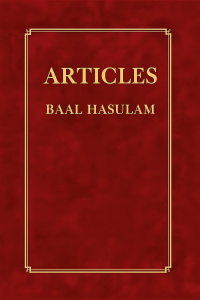
Rabbi Yehuda Ashlag is known as “Baal
HaSulam” for his rendition of the Sulam of The Zohar.
Born in 1885 in Lodz, Poland, he absorbed a deep knowledge
of the written and oral law in his youth, and later became
a judge and teacher in Warsaw. In 1921, he immigrated
to Israel with his family and became the rabbi of Givat
Shaul in Jerusalem. He was already immersed in writing
his own doctrine when he began to pen the commentary of
The Zohar in 1943. Baal HaSulam finished writing his commentary
of The Zohar in 1953. He died the following year and was
buried in Jerusalem at the Givat Shaul cemetery.
His eldest son, Rabbi Baruch Shalom Ashlag,
“the Rabash,” became his successor. His books are structured
according to his father’s instructions. They gracefully
elaborate on his father’s writings, facilitating our comprehension
of his father’s commentaries as handed down to our generation.
The Rabash was born in Warsaw in 1907
and immigrated to Israel with his father. Only after Rabbi
Baruch was married did his father include him in study
groups of selected students learning the hidden wisdom
of Kabbalah. He was soon allowed to teach his father’s
new students.
Following his father’s death, he took
it upon himself to continue teaching the special method
he had learned. Despite his great achievements, like his
father, he insisted on keeping to a very modest way of
life. During his lifetime he worked as a cobbler, construction
worker and clerk. Externally, he lived like any ordinary
person, but devoted every spare moment to studying and
teaching Kabbalah. The Rabash died in 1991.
Rabbi Yehuda Ashlag, the Baal HaSulam,
is the recognized spiritual leader for our generation.
He is the only one in this generation who has written
a fully comprehensive and updated commentary of The Zohar
and the writings of the Ari. These books, with the addition
of his son Rabbi Baruch Ashlag’s essays, are the only
source we can use to assist us in further progress.
When we study their books, we are actually
studying The Zohar and the Ari’s writings through the
most recent commentaries (of the past 50 years). This
is a life belt for our generation, since it enables us
to study ancient texts as if they had been written now,
and to use them as a springboard to spirituality.
Baal HaSulam’s method suits everyone,
and the sulam (ladder) he built in his writings
ensures that none of us need fear studying Kabbalah. Anyone
learning Kabbalah is assured that within three to five
years he will be able to reach spiritual spheres, all
realities and divine understanding, the name given to
that which is above and beyond us and not yet felt by
us. If we study according to the books of Rabbi Yehuda
Ashlag, the Baal HaSulam, we can reach true correction.
The study method is constructed to awaken
in us a desire to understand the upper worlds. We are
given a greater desire to get to know our roots and to
connect with them. We are then empowered to improve and
fulfill ourselves.
All three great Kabbalists are of the
same soul: first appearing as Rabbi Shimon, on a second
occasion as the Ari, and the third time as Rabbi Yehuda
Ashlag. On each occasion, the timing was ripe for further
revelation because the people of that generation were
worthy, and the soul descended to teach the method suitable
for that generation.
Each generation is increasingly worthy
of discovering The Zohar. What was written by Rabbi Shimon
Bar Yochai and hidden was later discovered by the generation
of Rabbi Moshe de Leon, and then by the Ari, who started
to interpret it in the language of Kabbalah. These writings
were also stored away and partly rediscovered when the
timing was right. Our generation is privileged to learn
from the Sulam, which enables everyone to study Kabbalah
and to correct himself now.
We see that The Zohar speaks to each
generation. In each generation it is more revealed and
better understood than in the generation before. Each
generation opens the book of The Zohar in a unique way,
suited to the roots of its particular soul.
Importantly, at the same time, an attempt
is made to conceal Kabbalistic writings so that those
feeling the need to seek them will discover them by themselves.
The Kabbalists evidently know that the process of change
requires two conditions: correct timing and maturity of
the soul. We are witnessing a very interesting occurrence,
characterized by the breakthrough and signaling of a new
era in the study of Kabbalah.