




Description
Rav Michael Laitman, PhD takes viewers on a captivating timeless journey through the path of Kabbalah
Transcript
Dialogues on Kabbalah
Listening to yourself
Rav Michael Laitman, PhD: Every person has a dot in his heart. This dot
must lead him forward, it must develop him correctly, but normally man
does not hear it. He hears only what he learns from the surrounding
world. He does not hear himself, his inner voice. He never works for
himself, but he always does what his environment or his education
dictate to him. The most important thing is to feel this inner voice,
this inner dot, and to learn to listen to it. For that purpose, man is
sent suffering which makes him start asking questions like, "What am I
living for?" "What do I need personally?"
To develop this dot, to achieve what he desires, he needs a special
book about how to hear this voice, discover his true self. We always do
what has to be done. We take examples from our surroundings, and
according to what they show us, we are constantly trying to put those
costumes and masks.
In order to help us find our own role in this world there's a method
called, "Kabbalah." Using this method, formulated by the people who
grasp the essence of man's soul, we can also do the same. The best and
easiest way to do that is to form a group since people who join it, ask
the same questions. They wish to hear their inner voice and know what
they live for—why they came to this world, and why they constantly have
to return to it—what's the reason for their suffering.
When such people come together, their inner desires merge. When they
study special, secret books, each one of them gets a powerful charge
from the rest of the group. And each one is able to achieve quickly
what his inner dot demands.
The Book
When you have this inner potential which makes you restless, when you
feel that something pulls you towards something you have no idea about,
you open a book containing all your inner states—and not just yours,
but of all souls—so naturally, if you open it with your inner voice,
the book will show you exactly your spiritual state. It's utterly
precise.
Moreover, perhaps not today, but soon, like most of the students in our
group, you will learn how to know what state you are in now, see your
previous and future conditions, the evolution of your soul. That is
because the Book of Zohar contains absolutely all spiritual states, of
all souls, of all times.
As the great Kabbalist, Ari, told his students about their previous
incarnations, so we can also see our past lives, the incarnations of
our souls. We can control our soul's evolution. Man can become so
powerful in this world that he will be able to know the entire prospect
of soul evolution, the advancement of humanity. He can rise above our
world and literally be in charge of the material world—transcending
time and space, life and death. Is it man's goal? It is. He has to
evolve so that nothing we see in this world would stand in his way. He
would instantly travel in time and space, covering unimaginable
differences—being in the past, the present, the future, simultaneously,
and in any place.
Interviewer: It sounds like science fiction.
No it doesn't. All these powers are stored in our soul and demands for us to implement them, use them, utilize them.
Interviewer: So is that why people suffer?
Yes, they suffer in order to realize that their low level of development, materialistic…
Interviewer: egoistic…
Well, that's irrelevant. It has always been egoistic and will continue
to be. Man does everything only for himself. Later he understands of
course that his well-being is only beneficial to others, and that other
people's well-being is good for him. Man can achieve such a state when
he really becomes a master of his own life, controlling his future. The
problem is in seeing the connections between cause and effect. By doing
something, I need to clearly see the consequences of my actions. For
that purpose, I have to see the picture of the entire universe.
Foreseeing the future
What is the meaning of pre-destination? Everything is pre-determined by
the Creator. And if I don't evolve on my own, then he evolves me, but
if I want to do it myself, that is, his thoughts will be my thoughts,
his desires will become my desires, so that I'll acquire completely all
his qualities, then I'll develop not according to His wish, but
according to my own.
Interviewer: That resistance?
Well not just with that resistance, but with great pleasure.
Interviewer: With no suffering?
Of course, without suffering. I will understand the purpose of this development.
Interviewer: What does it mean, "pre-determined?"
By saying that there are only two ways: the way of suffering, and the
way of intelligent evolution. We state that everything is
pre-determined. There is only one road, but you can go along that road
in a good or in a bad way. But it is predetermined.
Tell me, what is there in man that is not pre-determined? Everything in
you is determined by genes, hormones, in advance. Your environment, the
society you live in, provoke your reactions, based on your inner world.
All of your reactions and actions can be predicted. So what is not
pre-determined then? Where in man is there some empty space unknown to
us, allowing him to express his free will?
How would he realize this freedom? Based on his inner qualities,
knowledge, experience, for example, on pre-determined parameters? We're
just unfamiliar with all these systems. If we knew the internal and the
external systems of the universe, we would realize that there can't be
any unpredictable actions. All of them are absolutely predictable. It
is the same as looking at some small mechanisms, like molecules, or
atoms, we can predict what will happen to them. So man, being a huge
conglomerate of such small sub-systems, we're still unable to calculate
all his reactions, but in principle, it can be modeled quite
accurately. So it's just our ignorance of interconnections within this
closed system of the entire universe that allows us to say that there
is freedom of will in our behavior.
Our freedom of will is just a lack of knowledge. The true freedom of
will consists in realization of all essential levels, actions, of
thoughts, voluntarily seeing they are the most appropriate, natural,
and wonderful things to do.
On suffering
Isn't it inhumane? No, it isn't. Well it is inhumane, but it's not
man's prerogative; there is no other way. We can't free man from
suffering, since only upon completion of the way he acquires the
necessary sensations for rising above nature, time and space. He will
be able to move to any point in space in an instant, transcend the
boundaries of life and death, see his past lives and feel his future
states. He will simply become omnipotent, will satisfy all his
spiritual needs, he will reach his ultimate state, really becoming man.
And not just some creature, unaware of what is going to happen to it in
a moment, and how it will react.
Interviewer: What is in stake for me?
In stake for you is evolution up to a point when you can control all
your life simultaneously, when you will be seeing your past, present
and future, and treat them equally.
Interviewer: Let's talk about enjoying the Light, ok? What is prepared for me? What am I driven to by suffering?
You suffer in order to achieve the most perfect state. Suffering drives
you to self-knowledge. It is a process in which man finds within him a
most eternal, perfect supreme power, thought, action.
Interviewer: It sounds very general…
Does it?
Interviewer: Power, thought, action…What is prepared for me? What am I driven to? Why do I have to run there?
Because you feel bad.
Interviewer: I feel bad?
Of course you do.
Interviewer: Ok, I feel bad. So where am I driven to? Why do I have to run there? What's better for me?
You won't understand it. If you could understand it now, it would be
fine, but you don't. You're using your brain on this level. They drive
you to the next level, and when you reach it, you'll have an inner
powers and knowledge to realize where you were driven. But that's not
the case yet. That's what evolution is about.
Interviewer: Rav, where am I driven?
No-one can tell you that on your next level a million dollars are
waiting for you. On your present level, a million dollars is a reward
for you, while on the next, something different will be a reward, and
if you're shown it now, you'll take it as suffering. That's why your
next level is concealed from you.
Interviewer: Why should I take it as suffering? Show me a million dollars on my next level.
And it will look like how giving out, not like receiving. This is why
you need to evolve and reach the next level, hence the development of
Ohr (Light) and Kli (vessel) simultaneously.
Interviewer: So my goal is to become an altruist, give away a million dollars?
No. I can't tell you now what your next goal is, since it won't be a goal for you.
Interviewer: Rav, where am I driven? Where?
Towards your best state, which today, you can't see as such.
Interviewer: Why don't I want it?
Because it is totally opposite to your present state.
Interviewer: My present state is to be happy…
It is impossible to be happy in your present state.
Interviewer: Why?
Because it is brief and vicious. You can't be happy whilst filling a tiny desire of your soul.
Interviewer: On someone else's account?
No, it's not that. A well-satisfied cat, sleeping in the sun, is it a
normal state? It is. Is it a good state? Yes. For who? A cat. The
Supreme Power presses man to achieve more.
Interviewer: To achieve what?
It's impossible to say, to explain, to see your next spiritual level.
You want me to show your audience the world to come. There's no way to
describe it; it's a secret science. You can't do anything about it.
On Pleasure
One can't be truly delighted in this world because as soon as he satisfies his desire, he instantly loses taste for it.
If I eat a dinner I wanted so much, I feel its real taste. Only when I
started eating, then gradually my appetite disappears and I can't enjoy
it. So the pleasure that I receive destroys the pleasure. And I wish
the opposite. I want to receive infinite pleasure, but the more I would
eat, the more hungry I would become.
In our world, it does not exist. What should we do to be able to
receive pleasure endlessly? Both in quality and quantity, in our state
it is impossible. It is impossible to lead man to such a state when he
will enjoy endlessly. That is, the more that he receives, the more he
wants to receive. It's possible, only when pleasure comes in
combination with suffering.
Say I receive ten grams of pleasure, and instantly, I want twenty
grams. Receive those twenty grams, and immediately feel a desire for
thirty grams more. Nothing like that exists in our state; such a state
when Ohr and Kli, as we say in Kabbalah, exists simultaneously, is
called "spiritual."
There are no other worlds; they are all just man's inner state. So we
have to develop our soul, so that it will feel delight and suffering at
the same time.
If I eat a bowl of soup, I can enjoy only that, but if I give out a
thousand bowls of soup to other people, then I can enjoy the act of
giving a thousand times more.
So here, I have a purely psychological problem which can be solved
mentally: as long as I receive pleasure, it doesn't matter what actions
I perform, does it? So, all we have to do is change people's
consciousness, making them understand that regardless of our actions,
the goal is pleasure.
We usually see just external actions without knowing the intention
behind it. The problem is purely educational. This is what Kabbalah
deals with. But when a man rises to a level of unbounded giving, he
discovers in himself completely different powers, and that allows him
to break through the boundary between life and death.
What is the cause of death and the numerous illnesses and sufferings?
It consists in man's ability to just receive, without giving anything.
This way, he kills himself. Even dieticians and psychologists say that
it's better to eat a little of junk food, than a lot of good, healthy
stuff. So death is a result of constant absorption. So, the passage
between life and death, between perception of a common man and an
extra-sensitive person, or of one attaining the entire universe, is
based solely on this transition between egoism to altruism, whereas,
this altruism is for the benefit of man.
Revelation
Anyone who starts, starts working on his inner dot, enlargening,
widening it, begins to see in it various kinds of desires. As these
desires are developed, in contradiction to each other, since otherwise
they can't grow, man receives such states as boundless love or
boundless hatred. I used to talk about such state, sharing them with my
Rav. He laughed. He thought that this was a necessary period in my
evolution.
In the process of growing, man goes through different states. I see it
in my students. There are certain states which they are unable to
interpret, but I know what they feel.
In Kabbalah, there is no place for concealment. On the contrary, the
so-called "secret science" is intended for revealing all secrets. So,
when a student comes to me, he can't hide anything from me.
Interviewer: He tells you everything?
Practically everything.
Interviewer: There are things that man can't talk about…
Yes, and it's not that he conceals something; he just can't talk about it. But, it is clear to me what he feels.
We are all designed similarly. We're all climbing the same ladder; go
through the same states. So, his feelings are familiar to me. My
feelings were familiar to my Rav. I help if I can. Sometimes I deepen
his problem so that he could come to an important decision, experiences
the most important thing.
Interviewer: So you intentionally aggravate his situation?
Yes.
Interviewer: Intentionally?
Normally yes. This way I help him solve his inner conflict. Thus, he
gains experience, confidence, and is ready for the next step.
Interviewer: Can a man commit suicide?
No, in Kabbalah there is a safety valve. Man can be lead through
terrible ordeals by the Supreme Powers, and he will think that
everything is over—problems with people, in the family—but at the last
moment, when he realizes there's no solution, everything works out. If
he can't find a solution within him, then that is a solution, and then
he breaks through.
Interviewer: So man has to come to the brink?
Every time, yes, in order to understand that nothing is decided in this world. All decisions come from a Higher Level.
Interviewer: Does the Creator decide everything for us?
No, we do if we rise to the Creator's level. This boy doesn't live and
evolve so that the Creator would do everything for him. The Creator
wants him to do it. Man must come to such maturity when he will be able
to decide on his own.
Interviewer: Sasha, is it possible at all?
Sasha Demidov: Sitting here, looking at things from our point,
it seems impossible, but fortunately, at the last moment, there appears
a tiny, aluminous, sweet sensation inside, coming right through the
suffering, and little by little you begin to live again. Man wants to
escape suffering.
Interviewer: Why are you saying he has to go towards it?
It's impossible to escape, but if you manage to correctly, and clearly, and quickly understand, then you can overcome it.
Interviewer: Understanding is not always easy. Rav, what do you mean by understanding?
Understand the cause of suffering; the cause of suffering. That's our
main problem. We don't decide anything. We don't have to. We just have
to feel everything inside. Hence, it is a process of self knowledge.
Sasha Demidov: By "the cause of suffering," you mean the way it
is described in books? We could see the reason? Well, like in a
situation when somebody shoves me, so I punch him back, and I suffer
about hurting him, the reason being his shoving me.
The cause of suffering lies between us and the Supreme Power, but each
time, between my certain inner quality and a higher inner quality. As
soon as I come to a realization of this conflict, the problem
immediately gets solved.
Interviewer: Is this conflict between me and the Creator?
Yes.
Interviewer: Well, how can a common man understand it?
All these conflicting situations you encounter in the course of your
life, all pressure that you feel, all your discontent, is nothing but a
conflict between you and Him. Everything else is merely His
representatives, so to speak.
The Creator is the Supreme power, totally unsubstantiated, dresses in
all these attires out against you. You are alone against the Creator in
His disguises of this world.
Interviewer: So all enemies and murderers are nothing but His representatives.
Of course.
Interviewer: What's the difference between positive and negative
roles? How can I see a scoundrel as the Creator's representative? What
should I feel?
You should feel that He is playing his role, so that you could act out
yours; very much like in a theatre. But, you have to play your role,
evaluating yourself against this certain quality.
Sasha Demidov: Actually, I already came across a situation of
this kind. First I saw a villain before me, but then I realized that he
was sent to me for a purpose.
When a situation is settled, you see that the actors are unimportant.
He turned out not to be the villain; he only looked like one for a
short time. In general, it becomes very obvious it's only a show; a
small theatre, small meaning a very low level.
The Teacher
In principle, man can't escape from his inner-most desire, from what
his heart, his soul demands. So, I too lived and worked feeling some
discontent—every one of us feels it—but there was nothing I could fill
it with. And it started growing so fast that one evening I felt I
couldn't stay at home, as if unconsciously, I got out of the house,
jumped into the car and started driving. I couldn't imagine what I was
looking for.
I got to Bnei-Brak—I've been there a couple of times before—arrived at
a junction, I had no idea where to go. I rolled down the window. It was
raining outside, the wind was blowing hard. It was a dark February
evening, around 8 or 9 o'clock. I shouted to a man, who was waiting for
the traffic light to change, asking him, "Where do they study Kabbalah
around here?" He quietly instructed me to turn left, and go past an
orange grove, to a little synagogue. There, he said, they studied
Kabbalah.
I entered a small house, and notice six or seven old men of around
seventy, in semi-darkness, studying, and I asked them if they were
studying Kabbalah. And they nodded quietly and invited me in. I did.
I a few minutes they closed their books. I couldn't understand what they were studying.
Their leader called me up and enquired who I was. I told him that I was
from Rechovet, and explained that I was looking for a place where I
could study Kabbalah. "Alright," he answered, "I help you. Come
tomorrow and I'll give you a teacher."
The next day I was there, having no high hopes to find something. But,
one of the men I saw the previous night, sat down in front of me,
opened a book, and we started reading.
Those were the things I had tried to read on my own, but he started
explaining and commenting in such a way that in a few minutes I
realized it was exactly what I'd been looking for. His explanations
were so simple, so easy to understand. Foe many years I've been trying
to hear it, and now it was given to me.
At the beginning, there were a couple of lessons a week. Then, I
started coming every evening, then every morning. After two years, I
was allowed to move to Bnei-Brak, and live near them.
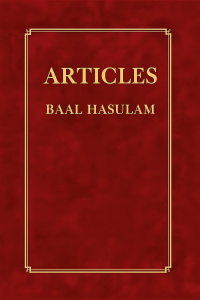
Gradually, I got closer to their leader, Rav Baruch Ashlag, the eldest
son of the famous Rav Yehuda Ashlag, Baal HaSulam—the author of
[commentary Sulam to] The Book of Zohar. I became his assistant,
secretary, driver; constantly accompanying him everywhere.
After a few months of studies, he came down with an ear inflammation,
and was to be hospitalized for a month. So, having to take him to the
doctor's, I found myself beside him, being involved in all his affairs.
I came to the hospital everyday, and I was with him most of the time. I
helped him communicate with the doctor, so we actually spent a whole
month in each other's company, studying together.
Every night at 3am, I came to the hospital; I climbed over the fence,
and studied together with him. Thus, we became close and spent days and
nights studying together.
It went on for twelve years. Many times—once every two weeks—we left
for Tiberias, or Mount Meron. It was a kind of a routine. Once a
fortnight, sometimes even once a week we left and studied only special
books, which corresponded only to the places that we went to. You
understand of course, that Mount Meron and Tiberias, are very special
Kabbalistic places.
Besides this, I studies with Rav from 3a.m. to 6a.m., from 5p.m. to
9p.m., in our synagogue, and from 9a.m. to 1p.m. we normally went to a
park and continued our studies while sitting on a bench, or walking.
Sometimes after returning from the park we studied for an hour or two.
So, it was actually learning non-stop. It was like one intensive lesson
lasting twelve years.
I hope that what happens to my students somewhat resembles what was between me and my Rav.
Interviewer: When Rav passed away, did it cut your…
Not at all. Kabbalists take such transitions in a totally different
way. The contact doesn't stop. Rising to a completely new level
requires a different mode of communication, but it is absolutely clear,
distinct, and conscious, based on a dialogue, as before.
Interviewer: Dialogue with Rav?
Certainly.
Interviewer: But Rav does not exist today.
Rav Laitman: What do you mean he doesn't exist? Before that, what did I address, a soul, or his body?
Interviewer: But you could see him.
Rav Laitman: So what? A Kabbalist is a person who developed a
sixth sense, totally independent of the other five sensory organs. So,
if a man succeeds in doing it, his teacher never parts from him.
They're connected by this inner sense.
To feel someone, I don't have to see, hear, feel, smell him; I don't
have to touch him. All in all, I feel only man's inner structure,
perceive him subconsciously.
Interviewer: Can you hear his voice?
It's inside me. Can you imagine your good friend talking to you? You
can hear his voice. Actually, it's not his voice that I hear; it is
perceived as pure knowledge, sort of inner contact, requiring no
transmits.