
|
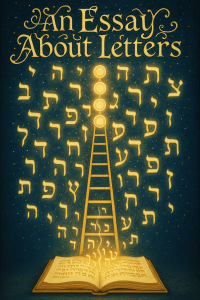
The Secret of the Letters
Lesson 1
A letter. What is it?
Impressions of man in spirituality
It was not said in vain that the world was created with letters. There
are twenty seven patterns and twenty seven laws, by which we are
activated, if we know how to respond correctly. These twenty seven
letters are within us.
We will respond correctly, when we will recognize the wisdom of the
supreme management and supervision of these letters.
To read letters is not like reading a story, but it is necessary to
know how to acquire their twenty seven attributes. Then, when a person
reads the words, he places his inner letters over the outer symbols,
and becomes included in the text. He enters the sensation of the upper
world, uniting and meeting with the author in that place where the
author composed each and every letter of the book.
A person, who acquires these twenty seven patterns or spiritual vessels,
would be able to read The Zohar and experience the same
sensations, same impressions that Rabbi Shimon felt when he was writing
the book.
During our times, when science, politics, and society in general are
lacking direction, this lack manifests itself in the way we feel about
the world, and in the realization that we do not have enough information
about the world we live in; we seem to have lost our way. The main
question is "how can humanity develop further?" We see that man is
gradually being pushed toward those all important questions, "what is
the point?", "what is life?", "what is this world I live in?"
Man feels the urgency of discovering the true reality; his lack of
knowledge regarding the true laws of reality is the reason for his not
knowing how to survive or how to cope with life.
Through thousands of years of experience humanity is discovering that
the perception of reality through the five senses is not sufficient and
that we constantly make mistakes. Since we realize that we lack
knowledge of the more inclusive, general laws we also understand that
we will never know how to behave with each other, with nature, and with
ourselves without understanding these laws.
The lack of understanding of the general reality in our days is
becoming a world wide problem that has to be resolved right now.
Through the wisdom of Kabbalah we can study the method for revealing the
powers of general reality; those forces that oversee and manage the
entire reality.
As the ancient books of Kabbalah proclaim, people will arrive to the
wisdom, and will begin to show interest and to occupy themselves with
it because they will discover the real nature of the wisdom of Kabbalah.
In order to gain the true sensation of our entire reality, which is
outside of the scope of our five senses, we must study it correctly.
Then, when we do, and want to grasp it, a new and wider world is opened
for us.
This new world is called the "upper world" or the "spiritual world";
soon we will begin to feel it. The question is, when I feel it, how do
I express my feelings? How would I research what I feel? How would I
pass this information to someone else? How can we share that reality
with someone who senses it as well?
This reality is a wider, upper, authentic reality.
Why "authentic"? Because I grasp it outside of me, not with my five
senses, it is what's happening outside of me, without me being in the
picture, as if things are occurring without me being there. It's
difficulty, because I have a sensation but I don't know how to name it.
I don't know how to name things that are happening to me, how to write
down the motions I feel.
A point in the white light
The Kabbalists use symbols that are derived from our reality to describe
it; the "reality" itself is "white light" - an upper light that has no
color, no shape. When man begins to sense the upper reality, this light
enters him a little bit, just enough for him to begin revealing it. He
becomes like a point in the light, and that is the beginning of the
"spiritual vessel". Later on, man develops towards that upper light,
towards that general law of reality. He begins to experience changes in
himself - of man, of reality, of the world.
A point, a line, right, left, up, down
Man senses the existence of motions and he describes them: right, left;
it is not similar to the right and left of our world but yet that is how
he feels, that the movements correspond to the occurrences of our world,
up, down and so forth. In addition to the point, lines begin to form in
him, and many more types of shapes.
We feel swings in our relationships; man feels changes inside of him,
different states that he senses as motion.
Those letters have to be written somehow. That's why Kabbalists invented
a language; the language of Kabbalah. Actually - letters.
Every impression includes 27 letters
Where do the letters come from? We learn that the light arriving to a
person expands in him, and gives him the purpose of his existence in
the world. This purpose is called (Taamim). It means that the
person feels purpose, taste, in the fact that he is in the world. Later,
when the pleasure, the light, the sense of purpose in being in the
reality of the world leaves him, it is called Nekudot -
"points". The points elevate, the feeling leaves the person. Black
points on a white background. The points are impressions of the
pleasure.
The memory of receiving something, a feeling, the sensation of the
passing purpose is called "Tagin".
The letters then are impressions of my existence in the world. They are
the lack, the desire for the next fulfillments.
According to this rule, a person first feels the expansion of the light,
then the coming of pleasure caused by the sensation of the light. It
fills him and later on leaves him. This process creates in a person a
lack, or a hunger for the light. From these actions and experiences we
build and construct ourselves repeatedly through the expansion and the
departing of the light,
This is how the letters are constructed -
In that exact way Kabbalists describe the letters of our alphabet,
through twenty seven letters: twenty two regular shapes and five ending
shapes.
Where are these shapes or letters, in this spiritual world that we are
studying?
When man investigates the spiritual world he finds in it parts that are
called Keter and Hochma, which he can not approach at
all. He can sense them, but he still doesn't have any impression of them
because they are above him. Together these two parts are called -
"Galgalta VeEynaim". Keter - Galgalta, and
Hochma - Eynaim.
There is also another part in which man does reveal the shapes, or the
forces acting on him. It includes - Bina, Zeir Anpin, and
Malchut. Together they are called AHP - (Ozen,
Hotem, Peh) ear, nose, and mouth - AHP. All of the letters
are our impressions of Bina. These are the shapes of letters
from Alef up to Tet. The letters of Zeir
Anpin are Yud through Tzadi, and the letters of
Malchut are Kuf, Resh, Shin and Tav. Twenty
two letters, plus the five final letters. Mem, Nun, Tzadi, Pey,
Kaf; These are letters of Malchut itself, and man can not
connect through these letters to the sensation of the upper world or
upper light.
However Keter, Hochma, Bina, ZA, and Malchut - which
are inside Malchut itself, assist Malchut, and in this
way there are twenty seven letters.
MANTZEPA"CH (Mem, Nun, Tzadi, Pey, Kaf) and
twenty two more letters
The letters, we may say, are Malchut - which is the "I" of the
person, which connects with all the behinot preceding it - the
impressions of man from the upper light at the level to which he can
enter the reality which is outside of him.
We normally grasp our world with our five senses - this is what enters
us. What enters me is my "I". That impression is what I call "my world"
or "this world". But if I sense what is outside of me, it is called the
"upper world", that is all the difference.
The extent to which man is able to move outside of himself and sense the
world - that would be the Malchut, ZA and Bina. Some
sense of Keter and Hochma can also be attained, but
since there are no letters there, man can not attain them with just his
vessel. It is a limitation that later on disappears, as we study in the
wisdom of Kabbalah.
Therefore all of our letters, for now, are MANTZEP"ACH
(Mem, Nun, Tzadi, Pey, Kaf) plus twenty two letters.
Each letter is a certain attribute of the upper world
In a person who begins to enter spirituality even to the smallest
degree, immediately any information he acquires includes all twenty
seven letters.
Even the smallest amount of light he grasps enables him to begin sensing
motions, understanding the interconnections of the letters, read the
books correctly and understand what a word is.
Each letter is a certain code, a rule or an attribute that man grasps
in the upper world. In "The Talmud of Ten Sefirot",
which is our main study book, we learn for example that the letter
Alef is constructed of an upper Yud - Galgalta
VeEynaim - that part of Keter and Hochma. The
lower part of the letter is - AHP, and the middle is what's
called Parsa: a border separating between the part which I can
reach, investigate, and the part that remains hidden from me.
Or for example there are letter shapes that cross the line. That is in
order for some light to be drawn from the upper world into the lower
world, and in that way revive the vessels, the souls that still can not
elevate, but that light would help them awaken.
There are completely closed letters, like the Samech and the
final Mem that point to the wholeness of the vessel, the
wholeness of the attainment. A person who enters a property like the
Samech, which is the property of Bina, is like in a
womb, something that wraps him, surrounds him, takes care of him, and
defends him like the ark of Noah - the same properties. The concept that
exists in spirituality called "womb of the mother" illustrates a state
where man is like a point, a fetus that goes up to the upper world so
that it would develop him and enable him to grow internally.
The letter Mem as well - "Mem (40) gates of impurity",
"Mem (40) gates of holiness", they all discuss the completeness
of attainment.
What is the completeness of attainment?
Man's movement up through three levels: from Malchut to
Zeir Anpin to Bina.
1. First level of attainment is the receiving or feeling of "light
of Nefesh".
2. Second level - he receives "light of Ruach".
3. Third level - he receives "light of Neshama".
Therefore our inner essence is called "Neshama" (soul).
There are two higher levels: Keter and Hochma which we
do not attain.
They are called Chaya and Yehida. Since we do not
attain them they have no shape and there is no possibility that we can
sense them clearly or express them to others.
Why do the letters express only a part of our sensation?
Even though we can investigate some of our feelings and write about
them or even make a science out of them, there are some forces that act
on us that we are still not capable of dealing with.
In the wisdom of Kabbalah it is expressed this way: We have the
possibility to investigate the upper world when we are in vessels of
bestowal, if we are in the property of "to bestow in order to bestow".
But if our state is that of "to receive in order to bestow" we are
unable to reach those upper worlds.
|