
Hebrew  | Russian  |  German  |  French  |  Italian  |  Spanish  |  Portuguese  |  Dutch  |  Polish  |  Hungarian | Norwegian

SwedishFinnish  |  Turkish  |  Bulgarian  |  Romanian  |  Greek |  Arabic  |  Amharic  |  Yidish  |  Latvian  

 Farsi   |  Georgian  |  Estonian  |  Filipino  |  Lithuanian  |  Ukrainian    |  Croatian  |  Japanese 

kabbalah.infokabbalah.info homepage kabbalah.info
Education Center | Kabbalah TV | Kabbalah Blog | Kabbalah Music | Online Store | Press | Archive | Contact | About


The Secret of the Letters

Lesson 2

The shape of the letters - the relation of Malchut to the light


There are many articles in the Zohar about the letters and I recommend that students read them.

Section A of the Zohar is an introduction, by Rabbi Shimon himself.

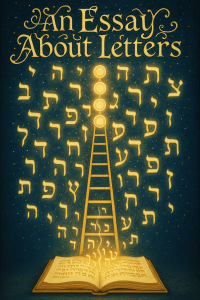
In that introduction there is "the article of the letters" called "Otiot De Rav Himnona Saba". In it Rabbi Shimon explains the shape of each letter, the attribute of each letter and why the letters have a certain order from Alef to Tav. He also explains the purpose of having exchangeable letters, why letters connect to a word in a certain way and how a word turns out to be a sequence of actions.

A letter symbolizes the range of my perception of the world around me

Each letter represents a certain attribute of the upper power for man, or the response of man to the upper force. We sense the world according to the degree of our similarity to it. The way I sense light waves, sound waves, and so on is an exact match to what happens outside of me.

Each and every letter marks a certain span in which I grasp the world around me. Through the twenty two letters and five more (27 total) I perceive the part of the world which is called AHP, and a small portion of GalgaltaVeEynaim, in an unspecified way.

Reading a sentence - flowing in the upper light

If I connect these properties together, I move from property to property, from sensation to sensation, from cause to effect. The connection of the letters in the form of a chain takes me from sensation to sensation allowing me to flow with the letters. By reading a sentence, we become a part of it, in the same way that we flow in the light. That flowing sensation brings us to a process and a purpose. That is how a Kabbalist feels when he reads letters.

The idea closely resembles a musician, who, when looking at musical notes, senses, and actually hears the music. He can look at those symbols, which mean nothing to us, and become emotional, cry, sing. For him it is everything because he feels the notes. For him they are symbols of inner sensations. So it is with the Kabbalist.

The study pulls man into the spiritual picture

When we read any Kabbalistic books, the text seems to us very dull. Why? Because at that moment we are not at a level in which we can grasp the information in an emotional form, like the author.

However, gradually we will attain this level by studying and reading. It takes time, months; it is a long path but it is the only path. The reading and the study itself, pulls man slowly towards it. He enters into the sensation, like in the movies - enters into the picture and begins to live it.

This process will happen to every single person, if they focus their energy during the reading of the books. The text contains power because it is written by people who sense the spiritual world, the upper world.

As you progress you will begin to see that besides the letters printed in the book, additional letters appear. It seems strange; the printing factory made the print exactly according to the original, and in general these processes are mechanical. But you will see - there are additional signs in the book. With a greater degree of perception you will see more things. Beyond the inner sensation that will appear, there will also be external signs.

Spirituality, which is the part in which you sense outside the body, will clothe the part in which you feel inside the body, like the merging of two worlds.

Then you will see that each letter, each word, and each connection of words that makes up a sentence in the sacred books, makes up one sentence from beginning to end.

The entire Torah is one long sentence, a sentence that takes the person from the beginning of correction to its end. When a person completes his correction; he is then at the highest level of development.

The world (Olam - concealment) was created with the letters

It is written that the world was created with the letters. The world (Olam) is concealment, and is also our vessels that were created by the letters. All that is concealed from us exists in a hidden form, an accurate form, in those patterns of the letters.

If we, in order to attain the spiritual reality, take upon ourselves to go through corrections, then we begin to sense that we have new possibilities of sensing reality through each one of the twenty seven corrections of letters. By studying each and every letter with its properties and copying them onto ourselves, the entire reality opens up in front of us - we begin to feel its breath.

There are some letters that are unique in their connection; those are ten names that can not be erased. They are the ten Sefirot, a permanent rigid structure of the entire reality. The ten Sefirot are ten levels of contact between the Creator and man.

The upper power called "Creator" is the power of Bina over us. As said, we have Keter, Hochma, and Bina, Zeir Anpin, and Malchut. Bina for us is the Creator. Zeir Anpin itself is made of six parts.

So ten Sefirot - ten names can not be erased. What does it mean "can not be erased"? They are like molds, permanent connections, establishments of a constant relationship of an upper level to a lower level.

The lower level is us. The upper level is that higher force.

E-L-O-H-I-M (God)

Why is the Creator called Bina here?

Because that is the maximum level we are able to attain, with which we can work. The relationship of that level to us has a name: Elokim.

Elokim in gimatria is nature. The relationship between the two forces is the nature of the upper world, or of general reality.

A question may be asked: if we describe the spiritual world using the Hebrew letters, can we describe those relationships, those same impressions and emotions of the upper reality in a different language?

No.

An English man, a Russian, a German, any person who would become a Kabbalist, who will enter the sensation of the upper world, will feel the relationships between the forces - the depiction of the Malchut, the point, over the upper light. He will feel the motion in the shape of Hebrew letters, and not in any other way.

How can a Russian prisoner write a song book in Hebrew?

There was a very special case, when I was still with my Rabbi: a man arrived from Russia. He has been in a labor camp, worked there very hard and spent a lot of time in jail. He did not know Hebrew and was very remote from Judaism, although he was Jewish. He arrived in Israel, around 1983-4.

I was then printing my first book. He found me, arrived to me and gave me a book of songs that he wrote there in prison - in Hebrew; with no knowledge of the language at all. It is a wonder. I barely understood what was written there. They used to write in a very high level Hebrew.

I brought the book to my Rabbi and he said that out of the suffering and out of the desire of man to understand what was happening to him, and why the world was treating him so harshly, he broke into the sensation of the world outside of himself. Outside of his sensation, out of feeling the upper world, he began to understand those symbols and wrote them down. And indeed they were amazingly beautiful songs. The words were so high that I could not understand ninety percent of them.

This is really a very unique example that shows that a man can really grasp the spiritual contemplation in such a way that the impression in him is a unique impression of letters.

The shapes of the letters describe for us in an accurate way the relationship between the forces and their relations that affect us.


The website kabbalah.info is maintained by
the
"Bnei Baruch" group of kabbalists

Copyright © 1996-2010. Bnei Baruch. All rights reserved.