
On the whole, science subdivides into two parts: the first is called
the knowledge of matter, the second – the knowledge of a form. This
means that there is nothing in the surrounding reality, in which matter
and form could not be discerned. For example, let us take a table. It
consists of matter, say, wood, and possesses a form of a table. Matter
(wood) happens to be a carrier of a form (a table). The same is with
the word “liar”: its matter is a man, and its form is “liar”, so that
the matter called man bears the form of falsehood.
This law is true for every object in the universe in both worlds; our
world and the spiritual one. A person consists of two parts: matter
and form. The human perception is divided in terms of these two parts,
whether it is still, plant, animated, or human nature, spiritual
Sefirot, or thoughts and feelings.
This perception has defined the division of the sciences which study
reality into two parts. One part studies the matter itself, i.e. what
constitutes the object. The other studies the form of the object, its
qualities and the way it is expressed outside. However, if a person
had different senses that allowed him to feel the reality in a
different way, the development of science would be different. It would
diverge, not in the two parts as research of matter and form, but
rather, would have completely different paths.
The part of science that deals with qualities of matter existing in
reality (both pure matter without its form, and also matter together
with its form) studies matter. For example, by studying the human
physiology, psychology, or anatomy, one studies human matter. This
research is empirical in its nature, i.e. it is based on the proofs
and results of practical experiments. Science takes these experiments
as a reliable basis for its conclusions. The absolute reality is
accepted due to the repetition of the experiments, which confirm
previous results. This is what forms the basis of science.
The other part of science studies only the abstract form, which is
disconnected from matter. In other words the forms “truth” and
“falsehood” are abstracts from matter, i.e. people, who are their
carriers. One looks only at the significance or non-significance of
these forms themselves in the pure state not being attached to any
matter. Such research does not have the empirical basis because the
abstract forms do not find their expression in practice confirmed by
experiments, and they exist outside the reality. In practice such
categories as falsity, truth, kindness, or treachery do not exist in
the “pure” form. These qualities are always attached to a person.
They become known only through their carrier, which is a person.
The above-said is also true for any other qualities: solidness,
rigidity, linearity, plurality, and so forth. The attainment of such
qualities is only possible in relation to certain objects. That is
why all the attempts to detach the qualities from their carrier and
study them in the abstract form are artificial. This is because the
abstract form is only the result of imagination and does not exist in
reality. Therefore any research of such a kind is based solely on
theory, i.e. it is not verified in practical experiments. It is only
an object of study based on a theoretical discussion type of analysis.
A study of abstract qualities such as kindness and altruism, detached
from a person and their idealistic portrayal, leads to a violent
perception. Such an approach serves as a ground for the creation of
communist and all other kinds of utopist theories that people have
later tried to implement by force in matter. However these theories
have nothing to do with matter. Matter is absolutely egoistic made up
by people - form is absolutely altruistic, and they do not match each
other in any way whatsoever. We can see such examples in practice:
attempts to build socialism and communism in Russia, kibbutzim in
Israel, and so forth. All these attempts failed badly lead to big
losses.
A person’s attitude to the spiritual world can be defined in the
analogical way. His perception of the spiritual world is based solely
on his fantasies. Looking at the expression of the surrounding reality
a person imagines that some quality, not being enclosed into a form,
exists in the spiritual, and he calls this quality “spiritual”. It is
obvious that this lacks any real basis. Nevertheless these far-fetched
imaginations became the basis for all kinds of “spiritual” theories,
philosophies, and religions. Lacking any practical proof they only
have confused, and keep on confusing, humanity. By occupying the
minds of billions of people, they are taking them away from the
natural, correct, empirical way of studying nature.
The above-said allows us to understand the difference between the
Science of Kabbalah and the rest of the Sciences. Kabbalah allows a
person to see, sense, and comprehend both the matter and the form in
their actual expression, in their tight inter-connection, when any
object of our as well as the spiritual world can be attained in
practice, by experiment. The science of Kabbalah also has two
aforementioned parts: matter and form. However, unlike the classical
sciences in Kabbalah, even the study of form is completely based on
the scientific research of practical perception, i.e. on the basis of
practical experience.
Having received the additional sense organ, a person enters the
concealed part of the universe that he did not before feel. He starts
to work there the same way as in the open part of the universe which
everyone can sense. His knowledge received this way is absolutely
reliable because it is gained empirically; the research results have
100%, there is repetition and the results can be verified by other
researches.
One of the Kabbalah laws states: anything that is impossible to attain
is impossible to name. This means that when an object is defined, a
name is given to its quality only after the object has been attained.
The attainment in Kabbalah is defined as the deepest understanding of
an object when a person attains, not only the object itself and its
form, but also the higher stage that gave birth to this object.
Giving birth means forming a goal of the object of existence, and all
the transformations that the object needs to go through in the cause
and effect chain until it acquires its final form. The sum of such
knowledge about an object is defined in Kabbalah as “attainment”.
Any science has a certain range of research and its abilities are
limited by the sensitivity of our five senses. We can raise this
sensitivity to some degree with the help of different devices, but
they will also have their limit. The science of Kabbalah gives a
person an unlimited volume of perception, but one should note that he
cannot be disconnected from the attainment of the objective reality.
The only thing that can be considered reliable is the one that a
Kabbalist is able to sense. These define the boundaries of research.
Therefore over the five thousand years of the existence of the Science
of Kabbalah, the Kabbalists have been very careful about passing their
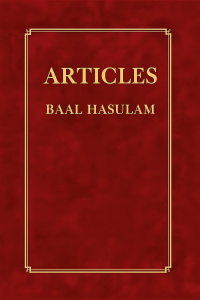
knowledge. This is shown particularly well in the Teaching about the
Ten Sefirot by Baal HaSulam who, explaining something that is
outside the understanding of another Kabbalist, writes: “Below a
personal assumption follows.” He puts a remark on any assumption that
is not based on the exact measurement. He never goes into depth when he
talks about such assumptions and neither he nor the readers of his
books accept these assumptions as true scientific facts. It is
worth mentioning that such categories as falsehood, truth, kindness,
egoism, and altruism, while being unattainable for other sciences,
can be attained by experimental way in Kabbalah as existent
categories. Psychology and philosophy study them as abstractions,
disconnected from matter. They conduct a study on a large number of
people and summarize the results. They give common names to similar
behavioral reactions and then start to analyze them.
The science of Kabbalah studies the qualities based on matter. This
matter is called “egoism” and it is this that is the object of
research. Therefore, the part that in regular science belongs to the
attainment of a form, in Kabbalah, belongs to the attainment of matter
which is real, absolutely scientific, and reliable. This sensation
exists in the additional sense organ created by the Kabbalist that has
the names soul, screen, or reflected light. Spiritual attainment takes
place only to the degree of similarity of a person’s qualities with the
Governing power which is the only thing that has an outside existence.
The Kabbalists have named this power as Creator.
A person who has created inside himself a quality that is similar to
the Creator can measure this quality and sense its expression on his
matter to the degree of his similarity with the Creator. In other
words he attains this quality. Since this quality is similar to the
Creator, it can be said that he has attained the Creator. Although
strictly speaking, attainment of the Creator, as the One existing
outside the person, does not happen. Anything that exists outside a
person is named by the Kabbalists as Atzmuto, which is the
essence of the Creator, and it is not attainable. The similarity to
the Creator’s qualities takes a person to the upper worlds. The word
world (Olam in Hebrew) has the same root with the word
concealment (Alama also in Hebrew). Attainment of the Creator happens
step by step, according to the creation of the spiritual vessel, and
achieving a similarity with Him.
The process of building a spiritual vessel happens in 125 steps called
the 125 steps of the worlds. A person is gradually proceeding up to
the total revelation of the Creator, to the absolute understanding of
the quality that is named Creator, as if it exists outside the person.
The words “as if” means that a person is not able to sense something
existing outside of his sense organs
Thus all the worlds exist in a person. They become revealed in him,
and they are nothing else than a partial similarity with the Creator.