




The
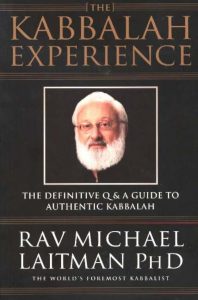
book The Kabbalah Experience: The Definitive Q&A
Guide to Authentic Kabbalah contains 430 pages of
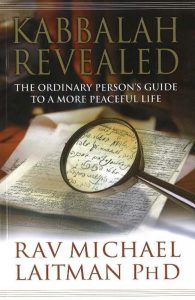
Rav Michael Laitman, PhD answering questions on
everything Kabbalah.
In
1999 and 2000, Rav Laitman ran an internet forum,
regularly answering all kinds of questions about
Kabbalah and on how Kabbalah relates to all sorts of
phenomena.
This book is a compilation of Rav Laitman’s answers on
these forums. Here you can get a direct answer to
whatever question a beginner might have.
This page contains selected Q&A’s from this book, and
is dedicated to the importance of voicing your
questions in the spiritual process.
Free
Download of this book: html
/
pdf /
buy for $11.97
The Purpose of Creation
Q:
Are we seeing an incorrect world?
A: The Creator started creation. To be more precise,
He created a world of “evil,” or corruption. But man
finishes creation, meaning man corrects it. Because
man hs the ability to lead the world, the Creator
passes onto him the leadership of creation. The
Creator increases the pressure on us to make us take
the leadership upon ourselves. That is why the world
around us is so bad; the Creator made it so, in order
that we begin to correct it.
p.
29, chapter "The Thought of Creation," in The
Kabbalah Experience: The Definitive Q&A Guide to
Authentic Kabbalah.
Free Download of this book: html
/
pdf /
buy for $11.97
Meaning of “Kabbalah”
Q:
What are the sources you usually cite regarding the
meaning of Kabbalah?
A: The
Kabbalist Rav Yehuda Ashlag, author of the Sulam
commentary on the Zohar, begins his article,
The Essence of the Wisdom of Kabbalah,
with the following definition: “…this wisdom is no
more and no less than a concatenation of roots that
descend by way of cause and consequence, with fixed,
determined rules, that combine to one exalted goal
being ‘the revelation of His Godliness to His
creatures in this world.’”
p.
71, chapter "The Wisdom of Kabbalah," in The
Kabbalah Experience: The Definitive Q&A Guide to
Authentic Kabbalah.
Free Download of this book: html
/
pdf /
buy for $11.97
Contradictory Opinions
Q:
Why is it that I always doubt ideas that I myself
presented a minute ago?
A: The truth is that everything changes within you all
the time. The contradictions in you astonish you, and
indeed it is astonishing to see how such many
contradictory views can exist at the same time in one
person, especially when changing from one minute to
the next.
This, in
fact, is how you are taught that everything is given
to you from Above, that everything stems from the
Creator, where all the contradictions merge into a
single perfection.
And it is
thanks to that merging, and your closeness with the
Creator, that you’ll be able to attain the
contradictions within you.
pp.
165/6, chapter "Spiritual Work," in The Kabbalah
Experience: The Definitive Q&A Guide to Authentic
Kabbalah.
Free Download of this book: html
/
pdf /
buy for $11.97
Happiness
Q:
What is happiness?
A:
Happiness is the sensation of the fulfillment of the
internal
capabilities of man. It is fully clarified only when
we realize precisely
what and
how we should fulfill, what are goal is, how eternal
it is and
independent, and to what extent it is the one
meaningful thing in the
world
that is now being realized.
In other
words, happiness is the sensation of nearing the
Creator,
because
that is the purpose of creation—a sensation of
advancement
toward a never-ending wholeness.
p.
384, chapter "Concepts in Kabbalah," in The
Kabbalah Experience: The Definitive Q&A Guide to
Authentic Kabbalah.
Free Download of this book: html
/
pdf /
buy for $11.97
Envy and Lust
Q:
What do I do with my jealousy, with my lust? Does the
Kabbalah
correct such attributes and the relationships between
people?
A: During
the study of Kabbalah, you are gradually influenced by
the
surrounding Light that changes you. It first happens
in small portions,
and later
on it becomes a perpetual process. Over time you might
appear to
be more egotistical, because you react differently to
external
stimulus,
relationships and pain, and people tend to interpret
it as carelessness
toward
them. In fact, you have simply begun to understand the
meaning
of what is going on. You do not cry anymore like
others do,
and you
do not panic. On the contrary, you want to give
everyone more
and more,
but you do it in a special way, through the correction
of the
universe
through yourself.
This love
for mankind, the greatest there is, can seem like pure
egotism.
Even
though you relate to people around you like a loving
father
who will
not give his child a knife to play with, others will
not understand
you. In
general, Kabbalah can be understood only by personal
experience.
Unfortunately only people with spiritual attainment
can enjoy
this type
of experience.
pp.
221/2, chapter "The Desire for Pleasure, Discovery and
Correction,"
in The Kabbalah Experience: The Definitive Q&A Guide to Authentic
Kabbalah.
Free Download of this book: html
/
pdf /
buy for $11.97
Senses Beyond Reason and Thought
Q:
Is it enough to use reason and logic in order to
understand
Godliness?
A: No
reason in the world will help us understand
spirituality,
because
it is above our reason and our minds. This is why we
can’t feel
it. Our
senses can only examine things they can grasp and
analyze, a
knowledge
that we generally refer to as “this world.”
In order
to feel the Upper World we must acquire other senses,
which we
call a “screen.” Only with a screen can we feel what
is above us,
beyond
our material sensation, which our natural senses
cannot detect.
When we
are able to sense the Upper World, we also receive a
different
mind and
a different reason. First, we get the wisdom and the
reason of
the Upper World. Only then do we begin to feel it. The
only
way to
acquire a screen is through the wisdom of Kabbalah.
pp.
106/7, chapter "The Study of Kabbalah," in The
Kabbalah Experience: The Definitive Q&A Guide to
Authentic Kabbalah.
Free Download of this book: html
/
pdf /
buy for $11.97
A Limited Ability to Act
Q:
Does the ability to lead the world necessarily demand
purification?
A: Yes.
To the extent that we purify, we merit the right to
determine
our own
destiny. Otherwise, we might harm ourselves and
others.
For
example, nature doesn’t give its powers to an infant,
for fear
he might
harm himself. Nature determines that the powers that a
person
receives
be proportional to one’s knowledge of how to use them.
The rule
that applies in the wisdom of Kabbalah is that a
person
will
never be allowed into the spiritual world and perform
a spiritual act
that
pertains to a greater measure of correction than one’s
own for fear
of
harming self or others. That is why the spiritual
forces that correct a
person
place one at a certain degree, and only in that
measure is one
included
in the system of the leadership. Hence, there is
nothing to be
afraid
of, because man cannot do anything of his own choice,
but only
out of
his degree.
p.
421, chapter "Reflections and Thoughts," in The
Kabbalah Experience: The Definitive Q&A Guide to
Authentic Kabbalah.
Free Download of this book: html
/
pdf /
buy for $11.97
Righteous and Evil
Q:
Can you please explain who is righteous and who is
evil?
A: Any
spiritual degree is divided in two parts: righteous
and evil.
If a
person justifies the Creator that person is regarded
as righteous,
while one
who condemns Him is regarded evil.
A person
who is in the world of Assiya is regarded as
evil, but in
the world
of Yetzira, that person is regarded as evil and
righteous. In the
world of
Beria, the same person is righteous. Before one
enters the spiritual
worlds,
one does not fall into any of the above categories,
because
from a
spiritual perspective one does not exist. Read a lot
of the texts of
Baal
HaSulam and Rav Baruch Ashlag, and learn the right
definitions
from
them. That will prevent you from being confused by
your previous
knowledge.
pp.
379/80, chapter "Concepts in Kabbalah," in The
Kabbalah Experience: The Definitive Q&A Guide to
Authentic Kabbalah.
Free Download of this book: html
/
pdf /
buy for $11.97